
What Instant Settlement, 24/7 Markets, and Stablecoins Actually Change
As traditional financial markets experiment with blockchain-based infrastructure — instant settlement, extended trading hours, and tokenized rails — the conversation is no longer theoretical. The question is no longer if Wall Street moves closer to on-chain systems, but what actually changes when it does.
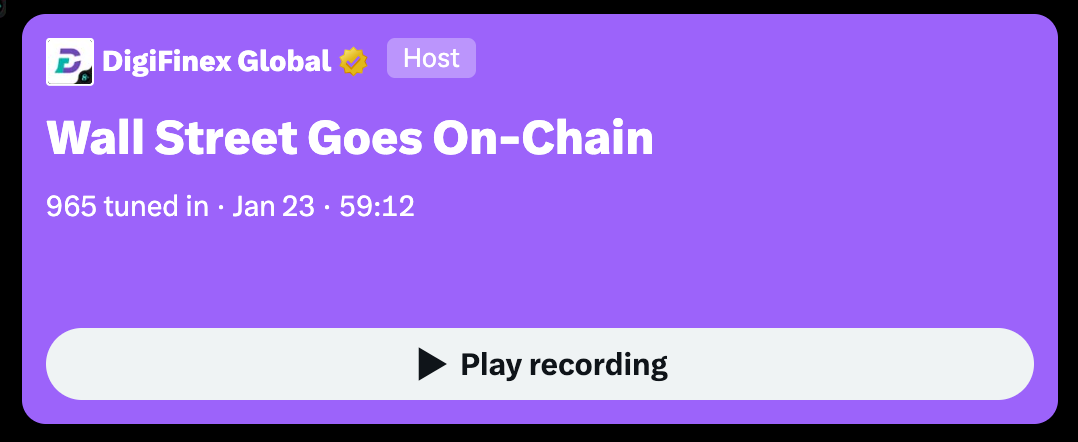
In this DigiTalk session, builders and data-layer teams discussed what these upgrades mean in practice: how market mechanics shift, how ownership feels different, and how user behavior may evolve when legacy finance adopts ideas crypto users have lived with for years.
Rather than focusing on price or speculation, the discussion centered on friction, access, control, and infrastructure.
Q1: What Everyday Frictions Does Instant Settlement and 24/7 Trading Actually Fix?
Francis (Forte AI) framed the impact as fundamentally human, not technical.
In traditional finance, users experience constant friction: trades that “complete” but don’t truly settle for days, capital stuck in limbo, and markets that close exactly when major news breaks. This creates hidden stress. Even when systems work as designed, users feel disconnected from their own money.
Instant settlement removes that uncertainty. When a trade finishes, ownership is final. There is no waiting period, no clearing risk, no question of whether capital will be accessible. Similarly, 24/7 markets eliminate the structural disadvantage faced by users outside U.S. market hours or in different regions.
However, Francis emphasized that speed alone is not the solution. Faster markets generate more data and more noise. The challenge shifts from access to understanding. As markets operate continuously, users need tools that translate activity into clarity. Without that layer, faster systems simply overwhelm participants rather than empower them.
Q2: Does Putting Wall Street On-Chain Actually Help Users — or Just Institutions?
DaGamma took a more cautious view, warning that moving legacy markets on-chain does not automatically democratize finance.
Instant settlement removes buffers that historically absorbed shocks. When markets operate continuously and at machine speed, volatility can cascade faster, especially when decision-making shifts from humans to automated systems. Encoding financial rules into software also raises questions of accountability: who controls the logic, and who is responsible when it fails?
From Gamma’s perspective, Wall Street adopting blockchain risks recreating the same power structures — only faster and less visible. The real value of crypto lies not in upgrading legacy finance, but in removing intermediaries altogether.
Unchained finance, without weekends, without permission, without geographic barriers, delivers benefits that legacy systems cannot replicate simply by using blockchain rails. Transparency remains the defining pillar. Without it, faster systems may benefit institutions more than users.
At the same time, Gamma stressed that real progress comes from teams that stay focused on long-term utility rather than narrative shifts. Many projects chase trends — tokenization one year, AI the next — but long-term trust is built by delivering real products that solve persistent problems.
Q3: If Settlement Becomes Instant, How Does Ownership Actually Feel Different?
Most users never think about T+1 or T+2 settlement cycles — until something goes wrong.
DaGamma explained that instant settlement fundamentally changes the experience of ownership. Value is no longer abstract or delayed. Assets feel usable immediately, especially across borders.
This matters most in real-world contexts: travel, payments, and cross-border activity. Traditional systems repeatedly fail users when they move between countries. Neo-banks still rely on the same legacy rails. On-chain systems offer a different model — one where access is not tied to geography or banking hours.
However, Gamma emphasized that liquidity alone is not enough. Transparency matters just as much. Knowing where value moves, why it moves, and what you actually own is the real upgrade. Ownership becomes tangible only when users can see and verify it.
Q4: What Happens When Stablecoins Are Used for Stock Settlement?
CryptoBurger described stablecoins as the bridge that collapses the old boundary between bank money and crypto money. Stablecoins are backed by fiat, but they move like crypto — always on, programmable, and instantly final.
If stablecoins become part of stock settlement, traditional finance begins using blockchain-native money at its core. Banks do not disappear, but their role shifts. They become issuers, custodians, and compliance layers rather than gatekeepers of movement.
This is not crypto replacing traditional finance. It is convergence. Money becomes programmable infrastructure.
DaGamma, drawing on experience in the European stablecoin sector, added that the industry will not support dozens of competing stablecoins indefinitely. As in every other industry, consolidation is inevitable. Trust, reserves, and accountability matter more than novelty.
Stablecoins unlock utility — yield, efficiency, cross-border access — but only when users understand the risks and standards improve. Long-term credibility requires transparency, restraint, and consistent reserve management. Without that, stablecoins replicate the same trust issues users face in legacy systems.
Q5: Does Bringing Equities On-Chain Change Crypto’s “Risk Asset” Behavior?
Mohammed (OptiView) offered a grounded answer.
In the short term, no. During macro stress, everything risky tends to move together. Putting equities on-chain does not break that correlation.
But long term, the framing may change. If crypto becomes infrastructure rather than just an asset, it stops being the thing investors speculate on and starts becoming the layer markets run on. At that point, crypto is no longer the risk — it is the system supporting risk assets.
That shift does not happen overnight. It requires time, adoption, and trust. But infrastructure rarely remains invisible once it becomes essential.
Q6: What New Risks Does “Always-On” Trading Introduce?
Again, Mohammed (OptiView) highlighted a human cost.
24/7 markets remove natural pauses. In traditional finance, market hours force rest and reflection. In always-on systems, users feel constant pressure to react. This increases emotional trading, burnout, and decision fatigue.
Always-on trading only works if users develop better limits, better tools, and better discipline. Speed without guardrails becomes a liability rather than an advantage.
This mirrors crypto’s long-standing reality. The difference is that traditional markets are now confronting the same psychological challenges crypto users have lived with for years.
Q7: What Parts of Crypto Culture Are Most Challenged as Institutions Adopt Blockchain?
DaGamma argued that crypto’s original promise — self-custody, transparent settlement, and removal of intermediaries — remains intact, but is increasingly misunderstood.
Institutional adoption often focuses on efficiency rather than empowerment. When users cannot see the benefit, education becomes critical. Without it, blockchain becomes just another invisible backend rather than a meaningful shift.
Education itself must evolve. Long explanations no longer work. Visual, experiential learning matters more than whitepapers. Crypto will not grow by telling people what it is — it will grow by letting people use it without friction.
The challenge is preserving crypto’s community-driven ethos while simplifying the experience enough for broader adoption.
Q8: Will “On-Chain” Eventually Disappear Into the Background?
DaGamma compared blockchain to electricity or internet wiring. Users do not need to understand it. They just need it to work. Innovation succeeds when complexity stays hidden behind simple interfaces.
When users can pay, trade, travel, or explore without thinking about protocols, wallets, or settlement mechanics, blockchain becomes infrastructure rather than identity.
Mohammed (OptiView)reinforced the analogy: no one wants to see the wires. They want to flip the switch.
Crypto does not need to be explained to be valuable. It needs to be seamless.
Conclusion
This discussion made one thing clear:
The future of crypto is not louder narratives or faster speculation.
It has a quieter infrastructure.
Instant settlement, stablecoin rails, and always-on markets do not change finance by themselves. They change finance only when paired with clarity, transparency, and user-first design.
As Wall Street moves closer to on-chain systems, crypto’s greatest test is not adoption — it is whether its original values survive the transition.
Comments
0 comments
Please sign in to leave a comment.